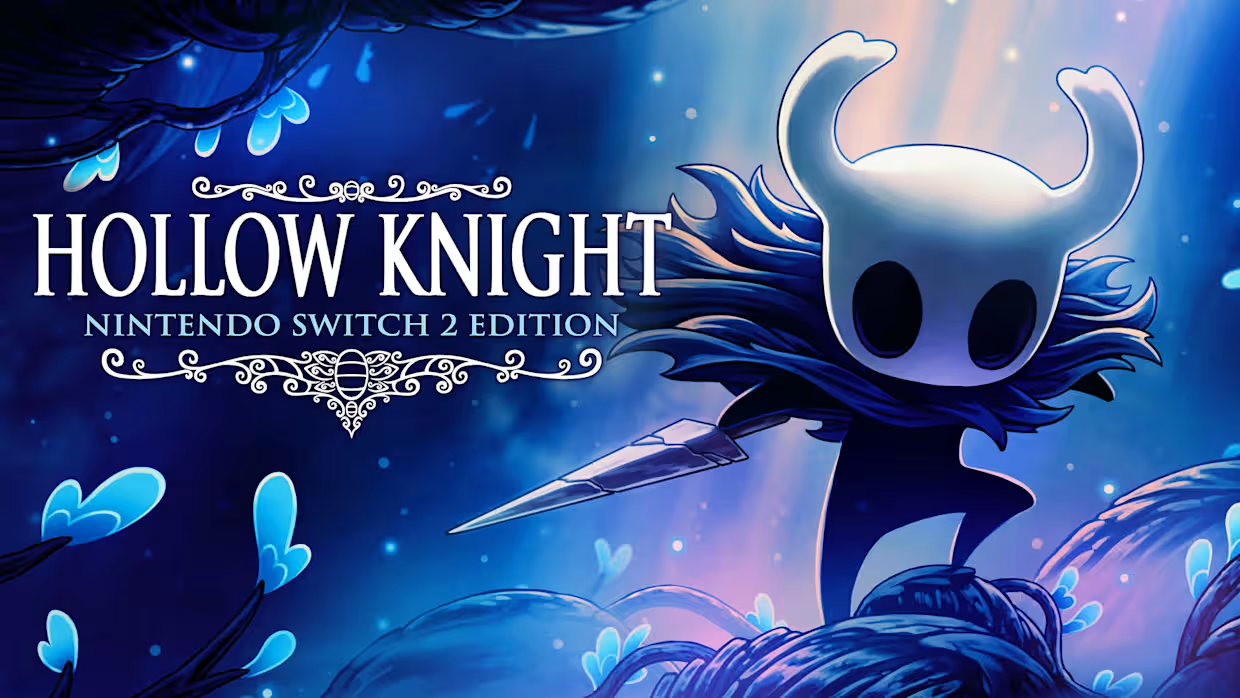
Few independent video games have reshaped their genre as profoundly as Hollow Knight. Developed by the small Australian studio Team Cherry and released in 2017, this atmospheric action-adventure title immediately set a high benchmark for level design, combat fluidity, and environmental storytelling. Set in the decaying, subterranean insect kingdom of Hallownest, the game invites players into a vast, interconnected world that balances melancholy beauty with uncompromising difficulty.
What began as a Kickstarter campaign backed by a dedicated core of indie enthusiasts quickly evolved into a critical and commercial phenomenon. Hollow Knight succeeds not merely because it pays homage to classical 2D exploration games like Super Metroid and Castlevania: Symphony of the Night, but because it refines those traditional mechanics into a cohesive experience. Every cavern, soundtrack cue, and enemy placement works in harmony to immerse players in a haunting world of fallen gods, tragic heroes, and hidden mysteries.
Understanding Hallownest: World Design and Atmosphere
The foundation of Hollow Knight rests upon its extraordinary world building. Hallownest is not just a backdrop for platforming; it functions as a living, breathing character in its own right. As players guide the silent Knight down from the quiet surface village of Dirtmouth into the depths below, they uncover a sprawling civilization ruined by a mysterious, mind-corrupting infection known as the Radiance.
Nonlinear Exploration and Interconnectedness
Exploration in Hollow Knight is characterized by open-ended player agency. Rather than forcing players down a rigid, linear path, the game continuously presents branching routes. Discovering a new area often relies on spatial awareness, trial and error, and intuition rather than explicit quest markers.
As players acquire new traversal abilities—such as the Mothwing Cloak for dashing or the Mantis Claw for wall-jumping—previously unreachable ledges and locked passages become accessible. The feeling of organic discovery is central to the experience. Returning to an early zone like the Forgotten Crossroads with mid-game upgrades transforms how players navigate the space, turning once-daunting chasms into fluid thoroughfares.
Environmental Storytelling and Aesthetic Contrast
Each zone within Hallownest possesses a unique aesthetic identity, environmental hazards, and narrative weight:
- Greenpath: Vibrant with overgrown flora and dripping acid, representing natural life attempting to reclaim the kingdom’s borders.
- The City of Tears: A majestic metropolis submerged in perpetual rain, echoing the tragedy of Hallownest’s former elite class.
- Deepnest: A claustrophobic, pitch-black labyrinth filled with treacherous terrain and arachnid threats, emphasizing isolation and vulnerability.
- The Abyss: The silent, abyssal depths where the dark origin of the Knight and the Vessels lies buried.
Team Cherry relies heavily on subtle visual details to communicate history. Statues, broken tablets, background corpses, and subtle shifts in lighting convey the fall of an empire without requiring lengthy exposition scenes.
Core Gameplay Mechanics and Progression
At its core, Hollow Knight is a 2D action-platformer that demands precision, timing, and patience. The gameplay loop seamlessly integrates exploration, resource management, character customization, and challenging combat encounters.
The Combat System: The Nail, Soul, and Spells
Combat relies on a simple yet deep set of mechanical interactions. The Knight’s primary weapon is the Nail, a sword-like blade used for directional strikes. Attacking downward allows players to “pogo” off enemies, spikes, and hazardous surfaces, introducing a high-skill movement option that blends platforming directly into combat.
Hitting enemies fills the Knight’s Soul Meter, creating a dynamic risk-reward dynamic:
- Healing (Focus): Players can hold a button to channel Soul and heal their health masks. However, focusing requires standing still for several seconds, leaving the Knight vulnerable to incoming attacks.
- Spells: Soul can alternatively be expended on powerful offensive abilities, such as the Vengeful Spirit (a long-range energy projectile), Desolate Dive (a devastating downward strike with invincibility frames), or Howling Wraiths (an upward area-of-effect wave).
This dual-use resource system forces players to make real-time tactical decisions during intense boss encounters: Do you spend your accumulated Soul immediately to restore missing health, or do you convert it into offensive spells to shorten the fight?
The Charm System and Customization
Player progression in Hollow Knight avoids traditional level-up stats in favor of a versatile modular upgrade mechanic known as Charms. Found throughout Hallownest or purchased from shopkeepers, Charms require a specific number of “notches” to equip, limiting how many effects can be active simultaneously.
| Charm Name | Notch Cost | Practical Application |
| Quick Focus | 3 Notches | Increases the speed of channeling Soul to heal, vital for aggressive bosses. |
| Mark of Pride | 3 Notches | Greatly increases the reach of the Nail, allowing safer spacing during combat. |
| Shaman Stone | 3 Notches | Amplifies the size and damage output of all magic spells. |
| Wayward Compass | 1 Notch | Displays the player’s exact location on the map, indispensable for exploration. |
| Fragile / Unbreakable Strength | 3 Notches | Significantly boosts physical Nail damage per strike. |
The flexibility of the Charm system allows players to tailor their character build to specific challenges. A player struggling with complex platforming sections like the Path of Pain might equip Hiveblood for passive health regeneration, while a player fighting a fast-moving boss might prioritize movement speed and quick spell casting.
Narrative Lore: The Tragedy of Hallownest
While the surface narrative of Hollow Knight is straightforward—a lone traveler exploring a ruined cavern—the underlying lore is complex and deep. Team Cherry presents its lore through cryptic dialogue with eccentric non-player characters (NPCs), item descriptions, and environmental clues, encouraging the community to assemble the historical puzzle together.
The Pale King and the Rise of the Kingdom
Long before the events of the game, a higher entity known as the Pale King arrived in the cavernous wilds, transforming into a wyrm to grant sentience and intelligence to the local insect population. Under his guidance, Hallownest expanded into a vast kingdom unified by law, trade, and architectural grandeur.
However, this prosperity came at the expense of an older power: the Radiance. A light-based deity worshiped by the moth tribe, the Radiance was forgotten as the insects turned their devotion toward the Pale King. Seeking to reclaim her influence, the Radiance began appearing in the dreams of Hallownest’s citizens, driving them mad and manifesting physically as an orange, glowing infection that mutated their bodies.
The Void and the Birth of the Vessels
Desperate to save his kingdom from total collapse, the Pale King turned to an ancient, primordial substance found in the depths of the world: Void. He reasoned that an entity composed entirely of Void would possess no mind to think, no will to break, and no voice to cry out in suffering—making it completely immune to the Radiance’s dream-based infection.
The King and his consort, the White Lady, spawned countless offspring, dropping them into the Abyss below to be filled with Void. Out of millions of discarded attempts, one child was selected as the “pure” vessel: the Hollow Knight. This chosen Vessel was raised to contain the infection within its body and was sealed inside the Temple of the Black Egg, anchored by three magical Dreamers who entered an eternal sleep to sustain the barrier.
The Downfall and the Player’s Journey
The tragedy of Hallownest stems from a fundamental flaw: the Hollow Knight was not completely void of emotion. An idea instilled by the Pale King’s affection caused a microscopic flaw in the Vessel’s purity, allowing the Radiance to slowly leak through the seals and corrupt the kingdom anyway.
By the time the player character—one of the many discarded sibling Vessels who escaped the Abyss—returns to Hallownest, the kingdom is already dead, inhabited only by mind-cleansed husk creatures and solitary survivors. The player’s quest involves uncovering this dark origin, slaying the three Dreamers, and determining whether to replace the failing Hollow Knight or destroy the infection at its true cosmic root.
Masterful Audiovisual Craftsmanship
Beyond its mechanics and lore, Hollow Knight stands out due to its artistic direction and musical composition.
Hand-Drawn Art and Animation
Every character, background layer, and visual effect in the game was hand-drawn frame by frame by artist Ari Gibson. The visual style utilizes traditional 2D animation techniques, giving movement a natural weight and personality.
Despite the monochromatic palette common in dark fantasy settings, Team Cherry makes effective use of color theory. Dynamic lighting, parallax scrolling background layers, and particle effects—such as falling ash in Kingdom’s Edge or glowing spores in the Fungal Wastes—give depth to a two-dimensional plane.
Christopher Larkin’s Iconic Score
The atmospheric depth of Hollow Knight is driven in large part by its orchestral soundtrack, composed by Christopher Larkin. Rather than relying on bombastic loops, the score adapts gracefully to the emotional requirements of each scene:
- “Dirtmouth”: A sparse, melancholic piano melody that highlights the loneliness of the decaying surface town.
- “City of Tears”: A sweeping composition featuring dramatic strings and delicate vocal solos, echoing the lost grandeur of a rain-soaked capital.
- “Mantis Lords”: A fast-paced, rhythmic harpsichord and string arrangement that complements one of the game’s most celebrated boss fights.
- “Sealed Vessel”: A tragic orchestral piece that mirrors the emotional weight of battling a corrupted sibling.
Free Content Expansions and Post-Launch Legacy
Following its original launch, Team Cherry supported Hollow Knight with four major content updates released entirely free of charge. These updates expanded the core map, introduced complex boss encounters, and added demanding optional challenges for dedicated players.
1. Hidden Dreams
This first minor update added new fast-travel mechanics via the Dreamgate, alongside two challenging optional boss fights: White Defender and Grey Prince Zote.
2. The Grimm Troupe
Introducing a dark, circus-themed questline, this expansion brought new Charms, fresh lore regarding the Nightmare Realm, and two of the most technically demanding boss encounters in the game: Troupe Master Grimm and Nightmare King Grimm.
3. Lifeblood
Focused primarily on mechanical balance and visual refinements, Lifeblood updated boss animations, enhanced sound effects, and added the Hive Knight boss fight within the Hive sub-zone.
4. Godmaster
The final and largest expansion catered directly to end-game completionists. Set in the Mind of the Godseeker, Godmaster added boss-rush arenas known as Pantheons, featuring upgraded versions of existing bosses and concluding with the ultimate challenge of the game: Absolute Radiance.
Frequently Asked Questions
Is Hollow Knight suitable for beginners to the Metroidvania genre?
While Hollow Knight is celebrated for its precise controls and satisfying progression, it features a steep difficulty curve, particularly during boss encounters and late-game platforming challenges. Beginners can certainly enjoy it, provided they are prepared for a game that emphasizes patient learning, spatial exploration, and frequent retry attempts.
How long does it take to beat Hollow Knight?
A standard initial playthrough focusing on the main story typically takes around 20 to 30 hours. However, fully exploring Hallownest, discovering secret areas, collecting all Charms, and completing post-launch expansion content like the Pantheons can easily push playtime past 60 to 100 hours.
What platforms is Hollow Knight available on?
Hollow Knight is available across all major gaming platforms, including PC (Windows, macOS, Linux), Nintendo Switch, PlayStation 4, PlayStation 5, Xbox One, and Xbox Series X/S.
What is the relationship between Hollow Knight and Hollow Knight: Silksong?
Hollow Knight: Silksong is the official full-scale sequel to the original game. Initially planned as a DLC expansion featuring the character Hornet, the project expanded dramatically in scope during development, leading Team Cherry to turn it into a standalone title set in a completely new kingdom named Pharloom.
Conclusion: The Enduring Impact of Hollow Knight
Hollow Knight remains a monumental achievement in modern independent game development. By taking the fundamental principles of the Metroidvania subgenre—backtracking, non-linear progression, and environmental storytelling—and executing them with precision, Team Cherry crafted an experience that feels timeless.
Its legacy lies not only in its challenging gameplay and rich lore, but in its respect for the player’s intelligence and curiosity. It offers a vast, intricate world that does not hold the player’s hand, trusting them instead to get lost, learn from failure, and ultimately conquer the tragic beauty of Hallownest. Whether evaluated on its art, music, level design, or combat precision, Hollow Knight stands firm as an undisputed masterpiece of modern gaming.