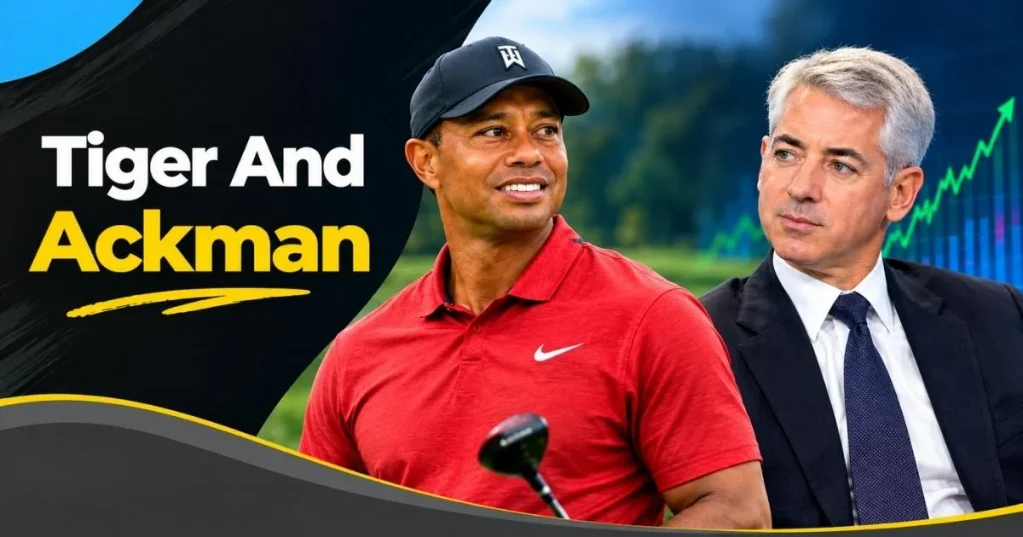
Bill Ackman and Tiger Woods are two prominent American figures who have made their mark in very different industries. Ackman is known for his investment strategies and leadership at Pershing Square Capital Management, while Woods is widely recognized as one of the most accomplished golfers in professional sports history.
Although their careers follow different paths, both have influenced the commercial world through their professional achievements, public reputations, and connections with major brands. Their names also illustrate how finance, sports, and corporate influence can intersect in unexpected ways.
Interest in Bill Ackman and Tiger Woods raises several questions. What connects an influential investor with a legendary golfer? Have they worked together professionally? And what can their careers teach us about long-term success, business strategy, and reputation?
Understanding their individual backgrounds and documented corporate connections provides a clearer picture of why these two public figures attract attention.
Who Is Bill Ackman?
Bill Ackman is an American billionaire investor and the founder and chief executive of Pershing Square Capital Management, an investment management firm known for its concentrated investment strategies and activist approach to public companies.
Born in 1966, Ackman studied at Harvard University, where he earned an undergraduate degree before completing an MBA at Harvard Business School. He subsequently developed a career in finance, becoming known for taking significant positions in companies and advocating changes he believes can improve their long-term performance.
Unlike investors who simply purchase shares and remain passive, activist investors may seek changes in corporate leadership, operations, financial strategy, or business structure. Their goal is generally to increase shareholder value, although their proposals can attract disagreement from company management and other investors.
Ackman has built a public profile through high-profile investment campaigns, market commentary, and his willingness to express strong opinions about business decisions.
Pershing Square Capital Management
Pershing Square Capital Management is the central business behind Ackman’s investment career. The firm is known for focusing on a relatively small number of investment positions compared with broadly diversified investment funds.
This approach can produce substantial gains when an investment thesis succeeds. However, concentrating capital also exposes investors to greater company-specific risk if a business underperforms or market conditions change.
Ackman’s career illustrates the importance of research, financial analysis, and conviction in investing. It also demonstrates why even experienced investors must continually reassess their assumptions.
Financial markets are unpredictable, and a well-reasoned investment decision does not guarantee a profitable outcome.
Who Is Tiger Woods?
Tiger Woods, born Eldrick Tont Woods in 1975, is one of the most recognizable athletes in the history of professional golf. His combination of technical ability, competitive intensity, and commercial influence helped transform the sport’s public profile.
Woods demonstrated exceptional golfing talent at a young age and achieved major success as an amateur before turning professional in 1996. His rapid rise brought new attention to professional golf and established him as one of the sport’s leading figures.
His victory at the 1997 Masters Tournament became a defining moment in golf history. At just 21 years old, Woods won by 12 strokes, setting a record for the largest margin of victory at the Masters.
Over the following years, he accumulated major championship victories and became a global sports icon.
Tiger Woods and His Lasting Influence on Golf
Woods’s influence extends beyond tournament results. His success attracted new audiences, strengthened interest in professional golf, and demonstrated the commercial potential of elite athletes.
His playing style combined power, precision, course management, and an ability to perform under pressure. These qualities helped him establish a reputation as a formidable competitor.
His career also included serious injuries, personal challenges, and periods away from competition. His victory at the 2019 Masters was particularly memorable because it followed years of physical difficulties and uncertainty about whether he could return to the highest level.
Woods’s career demonstrates that long-term success often involves setbacks and adaptation rather than uninterrupted achievement.
What Connects Bill Ackman and Tiger Woods?
The most notable publicly documented corporate connection between Bill Ackman and Tiger Woods involves Nike, the sportswear company.
Woods developed a long-standing endorsement relationship with Nike after turning professional in 1996. The partnership made him one of the company’s most recognizable athlete representatives and helped connect the brand with golf fans around the world.
Ackman’s connection to Nike came through investment activity. Pershing Square Capital Management disclosed a significant investment in the company in 2024.
These separate professional relationships help explain why people may search for Bill Ackman and Tiger Woods together.
However, it is important to understand that their connections to Nike are different. Woods was an athlete and commercial partner, while Ackman’s firm approached the company as an investor.
An investment in a publicly traded company does not automatically create a personal or professional relationship with every athlete associated with that business.
Why Nike Matters
Nike provides an example of how sports and finance can intersect through a single corporation.
For Woods, the company represented a long-term commercial partnership built around athletic performance, sponsorship, and brand recognition.
For Ackman, Nike represented an investment opportunity that could be evaluated through its financial performance, competitive position, brand strength, and future prospects.
Both relationships demonstrate the importance of corporate reputation, but they involve different responsibilities.
Athletes must maintain their performance and commercial appeal, while investors must assess whether a company’s market value accurately reflects its long-term prospects.
The connection illustrates how a major brand can bring together athletes, investors, customers, and corporate executives without requiring those individuals to work directly with one another.
Are Bill Ackman and Tiger Woods Business Partners?
There is no established public evidence confirming that Bill Ackman and Tiger Woods are direct business partners or have jointly operated a business venture.
Their separate connections to Nike should not be interpreted as proof of a personal relationship, joint investment, or shared business strategy.
Understanding the distinction between different types of professional connections is important when researching prominent public figures.
A direct business partnership generally involves a documented joint venture, shared ownership, or another clearly established professional arrangement.
An indirect corporate connection occurs when two people have separate relationships with the same company. One person may be an investor, while the other may be an employee, executive, athlete, or brand ambassador.
Industry overlap is broader still. Two individuals can work in related commercial environments without having any direct professional relationship.
In the case of Ackman and Woods, the Nike connection provides a reasonable explanation for public interest in their names together. It does not establish that they have collaborated directly.
What Their Careers Reveal About Success
Although Ackman and Woods work in different fields, their careers offer several useful lessons about performance, decision-making, and professional development.
1. Preparation Is Essential
Ackman’s investment activities require detailed company research, financial analysis, and an understanding of business strategy. Woods’s career reflects the importance of technical practice, physical conditioning, and mental preparation.
Both professions reward people who prepare carefully before making important decisions.
However, preparation cannot eliminate uncertainty. An investor may lose money despite thorough research, just as a golfer can make mistakes during an important tournament.
Preparation improves decision-making, but it does not guarantee success.
2. Reputation Creates Opportunities
A strong professional reputation can open doors to new opportunities.
Ackman’s reputation as an investor helps attract attention from financial markets, corporate executives, and other investors. Woods’s reputation as an elite golfer contributed to sponsorship opportunities, commercial partnerships, and worldwide recognition.
In both cases, credibility developed through years of professional activity.
Yet public visibility also brings greater scrutiny. High-profile decisions and personal setbacks can affect public perceptions, sometimes creating challenges that extend beyond the immediate professional situation.
For entrepreneurs and professionals, maintaining credibility requires consistency, accountability, and an ability to respond constructively to criticism.
3. Long-Term Success Requires Adaptation
Neither investing nor professional golf rewards inflexible thinking.
Investors must reconsider their expectations when a company’s financial position changes, competition intensifies, or economic conditions shift.
Golfers must adjust to changing course conditions, evolving competition, physical limitations, and the demands of different tournaments.
Woods’s return to win the 2019 Masters illustrates the value of persistence and adaptation. His comeback followed years of physical challenges that had interrupted his career.
Ackman’s investment career similarly demonstrates the need to evaluate investment assumptions against changing business conditions.
Long-term thinking does not mean refusing to change direction. It means remaining focused on an objective while responding to new evidence.
4. Financial Success Can Follow Different Paths
Ackman and Woods illustrate two different models of wealth creation.
Ackman’s career is primarily associated with investment management. His professional results depend on investment decisions, market conditions, and the performance of the businesses in which his firm invests.
Woods built his financial success through professional golf, endorsement agreements, and business activities associated with his reputation as an athlete.
These models have different risks and revenue structures.
Investment managers face market volatility and the possibility of losses. Professional athletes face competition, injuries, limited career longevity, and changes in sponsorship demand.
Both careers show that professional success often involves combining specialized skills with the ability to identify and pursue opportunities.
The Business of Sports and Financial Influence
The interest in Bill Ackman and Tiger Woods reflects a broader relationship between professional sports, corporate branding, and financial markets.
Athletes can become valuable commercial partners because their achievements and public identities help businesses reach consumers. Investors can influence companies through capital allocation, shareholder advocacy, and public assessments of corporate performance.
Nike illustrates how these different forms of influence can coexist.
The company’s commercial identity has been shaped by product development, marketing, athletes, and consumer demand. Woods’s endorsement history represents the importance of athlete partnerships, while Ackman’s investment activity reflects the perspective of a shareholder evaluating business performance.
These roles can contribute to discussions about brand value, corporate strategy, and long-term growth.
However, it would be inaccurate to assume that Ackman’s investment decisions were driven by Woods or that Woods’s commercial decisions were influenced by Ackman without evidence establishing such a relationship.
The broader lesson is that companies operate within networks of stakeholders whose interests sometimes overlap but are not necessarily coordinated.
How Public Figures Influence Business Decisions
The careers of Ackman and Woods also demonstrate that influence can take several forms.
An investor may influence business decisions by acquiring shares, presenting strategic proposals, or challenging management practices. An athlete may influence consumer behavior by representing products, attracting audiences, and strengthening a company’s public image.
Neither form of influence is unlimited.
Investors must persuade other shareholders and operate within corporate governance structures. Athletes must maintain commercial credibility and recognize that consumer preferences can change.
Businesses also have to balance the interests of investors, customers, employees, and commercial partners.
Understanding these differences helps explain why public figures from seemingly unrelated industries can become relevant to the same corporate discussion.
It also provides a useful reminder that association with a major brand does not necessarily imply agreement, collaboration, or a direct relationship between everyone connected to that brand.
Frequently Asked Questions
What is the connection between Bill Ackman and Tiger Woods?
Their clearest documented corporate connection is Nike. Woods had a long-term endorsement relationship with the company, while Ackman’s investment firm disclosed a Nike investment in 2024. This represents an indirect corporate connection rather than proof of a direct partnership.
Are Bill Ackman and Tiger Woods friends?
There is no established public evidence confirming a close personal friendship between Ackman and Woods. Their documented professional histories are distinct, and it is best not to speculate about their private relationship.
Did Bill Ackman invest directly in Tiger Woods?
There is no established public evidence that Ackman invested directly in Woods personally. Ackman’s documented connection involved an investment in Nike through Pershing Square Capital Management.
Is Tiger Woods involved with Pershing Square Capital Management?
There is no established public evidence that Woods is a partner, executive, or investor in Pershing Square Capital Management.
Why is Nike important to their connection?
Nike provides a clear example of their separate professional relationships with the same company. Woods represented Nike as an athlete, while Ackman’s firm approached the company as an investor.
What is Bill Ackman best known for?
Ackman is best known for founding Pershing Square Capital Management and pursuing high-profile investment strategies, including activist investing. His work focuses on evaluating companies and seeking to improve their long-term performance.
What is Tiger Woods best known for?
Woods is best known for his exceptional Bill Ackman and Tiger Woods golf career, including 15 major championship victories and 82 PGA TOUR wins. He is also recognized for helping expand golf’s popularity and commercial reach.
What can entrepreneurs learn from Bill Ackman and Tiger Woods?
Entrepreneurs can learn the importance of preparation, strategic thinking, reputation management, and adaptability. Their careers also demonstrate that success requires different skills depending on the industry and that no approach eliminates uncertainty.
Conclusion
Bill Ackman and Tiger Woods represent two distinct forms of professional achievement. Ackman built his reputation through investment management and corporate strategy, while Woods became one of the most accomplished golfers in modern sports history.
Their clearest documented connection is Nike, a company associated with Woods’s long-term endorsement history and Ackman’s investment activity. This connection illustrates how sports, corporate branding, and financial markets can intersect without requiring a direct relationship between the people involved.
Although public interest may encourage speculation about a personal or business partnership, there is no established evidence confirming that Ackman and Woods have jointly operated a business venture.
Ultimately, their separate careers offer valuable perspectives on preparation, reputation, risk, and long-term success. Understanding their individual achievements and the nature of their corporate connection provides a more accurate picture of how influential figures from sports and finance can become linked through the business world.