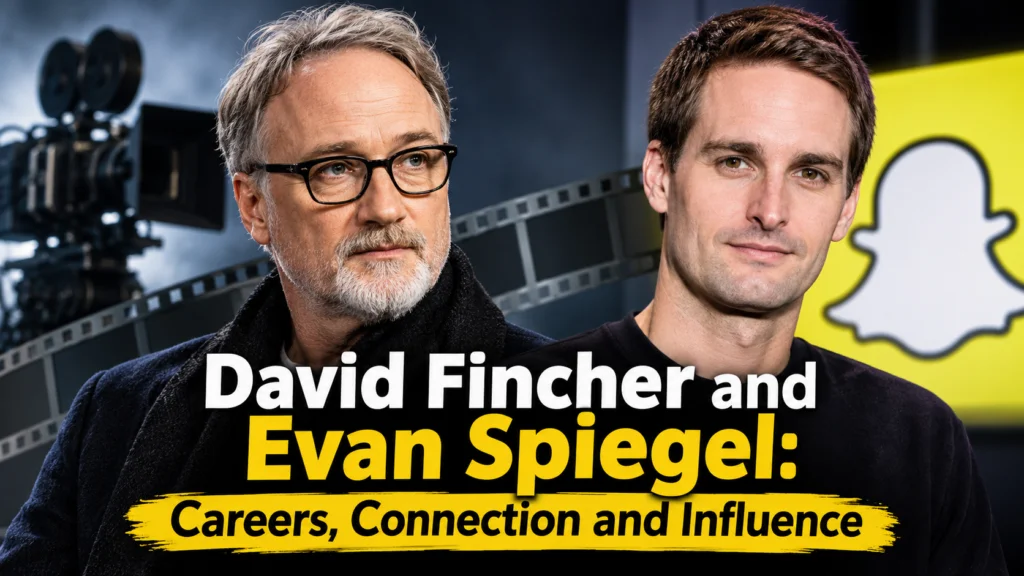
David Fincher and Evan Spiegel are influential figures who represent two very different sides of modern culture. Fincher has earned recognition as a filmmaker known for psychological thrillers, carefully constructed narratives, and visually distinctive storytelling. Spiegel, meanwhile, has become a prominent technology entrepreneur through his role in creating Snapchat and helping shape the way younger generations communicate online.
At first glance, their careers appear to have little in common. One works primarily in film and entertainment, while the other operates in technology and social media. However, looking at David Fincher and Evan Spiegel together offers an interesting opportunity to explore how creativity, ambition, innovation, and cultural influence operate across different industries.
Their professional journeys also highlight a broader relationship between entertainment and technology. Films increasingly examine the influence of digital platforms, while social media companies use storytelling, visual communication, and creative design to attract audiences.
Understanding their individual backgrounds helps explain why both names remain relevant in conversations about modern media, creativity, and the changing relationship between technology and popular culture.
Who Is David Fincher?
David Fincher is an American film director and producer recognized for his precise filmmaking style, atmospheric visuals, and interest in complicated human behavior.
Born on August 28, 1962, in Denver, Colorado, Fincher developed an interest in filmmaking at an early age. His career included work in visual effects, music videos, and commercials before he became widely recognized as a feature-film director.
His approach to filmmaking is often associated with careful preparation, controlled cinematography, detailed production design, and stories that explore psychological tension.
David Fincher’s Most Recognized Films
Fincher has directed several influential films that have attracted critical attention and established his reputation in Hollywood.
Some of his best-known projects include:
- Se7en (1995): A psychological crime thriller following two detectives investigating a series of disturbing murders.
- Fight Club (1999): A provocative film exploring identity, consumer culture, masculinity, and social dissatisfaction.
- Zodiac (2007): A crime drama based on the investigation of the Zodiac Killer.
- The Social Network (2010): A dramatization of the early development of Facebook and the personal conflicts surrounding its creation.
- Gone Girl (2014): A psychological thriller examining marriage, media attention, and public perception.
- Mank (2020): A black-and-white drama about screenwriter Herman J. Mankiewicz and the development of Citizen Kane.
These films demonstrate Fincher’s interest in characters facing difficult decisions, complicated relationships, and environments where appearances do not always reflect reality.
His Connection to Technology Through The Social Network
Among Fincher’s projects, The Social Network is particularly relevant when discussing technology entrepreneurs.
The 2010 film explores the early development of Facebook, focusing on ambition, friendship, competition, intellectual property, and the personal consequences of building a major technology company.
Although the film is not a documentary, it introduced many viewers to the dramatic human stories behind Silicon Valley entrepreneurship.
Aaron Sorkin wrote the screenplay, while Jesse Eisenberg portrayed Mark Zuckerberg. Fincher’s direction helped transform a technology-business story into an engaging character-driven drama.
The film is an important starting point for understanding why David Fincher’s name sometimes appears in broader discussions about technology leaders, including entrepreneurs such as Evan Spiegel.
Who Is Evan Spiegel?
Evan Spiegel is an American entrepreneur best known as the co-founder and chief executive officer of Snap Inc., the company behind Snapchat.
Born on June 4, 1990, Spiegel studied product design at Stanford University. During his time at Stanford, he worked with fellow students Bobby Murphy and Reggie Brown on an idea that eventually developed into Snapchat.
The original concept focused on a different approach to online communication. Instead of encouraging users to publish permanent, highly polished updates, the platform emphasized photographs and videos that could disappear after being viewed.
This concept helped Snapchat establish a distinct identity in an increasingly competitive social media market.
The Creation and Growth of Snapchat
Snapchat launched in 2011 and introduced a communication experience centered on temporary visual messages.
Its development reflected a simple observation: people often want to share everyday moments without creating permanent records of every interaction.
Several features helped the platform develop its identity:
- Disappearing messages: Users could exchange photographs and videos designed to disappear after viewing, depending on the settings and circumstances.
- Stories: This feature allowed users to share collections of photographs and videos that remained available for a limited period.
- Augmented reality lenses: Interactive camera effects introduced new ways to create and personalize visual content.
- Snap Map: Users could share location information with selected friends through an interactive map.
- Visual messaging: The camera-first interface encouraged users to communicate through photographs and videos rather than relying exclusively on written posts.
These features helped Snapchat become an important part of the social media landscape.
Spiegel’s role has extended beyond introducing a popular messaging application. As CEO, he has been involved in shaping Snap’s product direction, business strategy, partnerships, and approach to digital communication.
According to Snap’s official leadership information, he has served as the company’s CEO and a member of its board since May 2012. Leadership Team+1
David Fincher and Evan Spiegel: Is There a Direct Connection?
One important question behind the keyword David Fincher and Evan Spiegel is whether the two personalities have worked together or share a documented professional relationship.
Their names can appear in the same conversations because both have influenced modern media and digital culture. However, their professional careers belong to different industries.
David Fincher directed The Social Network, a film about Facebook’s early development. Evan Spiegel co-founded Snapchat, another major social media platform that emerged from a different entrepreneurial environment.
There is no widely established public record of a direct creative partnership between Fincher and Spiegel.
Understanding this distinction is important because online searches sometimes combine prominent names without indicating an actual collaboration.
The Social Network and Snapchat’s Different Stories
The Social Network premiered in 2010, before Snapchat launched in 2011.
The film presents a dramatized account of Facebook’s early development and the relationships surrounding its creation. Its central themes include ambition, competition, ownership, friendship, and the consequences of rapid technological success.
Snapchat’s development followed a different path.
Rather than focusing on a public profile and permanent social updates, Spiegel and his co-founders explored temporary visual communication and more private interactions.
The contrast provides an interesting perspective on how different entrepreneurs approached the same broad challenge: helping people communicate through technology.
Comparing Their Professional Approaches
Although Fincher and Spiegel work in different fields, comparing their careers reveals several interesting similarities and differences.
| Area | David Fincher | Evan Spiegel |
|---|---|---|
| Industry | Film and entertainment | Technology and social media |
| Primary role | Director and producer | Entrepreneur and CEO |
| Main focus | Storytelling and cinematic experiences | Digital communication and product design |
| Notable work | The Social Network | Snapchat |
| Creative approach | Visual precision and narrative detail | Interactive and camera-first communication |
| Cultural influence | Film, television, and popular culture | Social media and digital interaction |
Creativity and Attention to Detail
Fincher is widely associated with an exacting approach to filmmaking. His projects often involve detailed visual planning, carefully controlled performances, and extensive attention to the atmosphere of individual scenes.
Spiegel’s professional background in product design provides a different perspective on creativity.
Technology products require decisions about how people interact with interfaces, how features work together, and how design choices influence user behavior.
Both approaches demonstrate that creativity involves more than producing an attractive final result. It also requires understanding the audience and making deliberate decisions about the experience being created.
Understanding Human Behavior
Human behavior is central to both careers.
Fincher frequently explores psychological subjects such as obsession, identity, manipulation, ambition, and relationships. His films encourage audiences to examine why people behave in particular ways.
Spiegel’s work in social media involves understanding how people communicate, share experiences, and maintain relationships through digital platforms.
The difference lies in how these interests are expressed. Fincher explores human behavior through fictional and dramatized narratives, while Spiegel’s company develops products used for real-world communication.
Neither approach should be confused with the other, but both demonstrate the importance of understanding human motivations.
How The Social Network Changed Conversations About Technology Entrepreneur
David Fincher’s The Social Network remains one of the most recognizable films about the modern technology industry.
Its importance extends beyond its depiction of Facebook’s early history. The movie encouraged audiences to think about the personal and professional challenges associated with building successful technology companies.
Entrepreneurship Beyond the Success Story
Popular discussions about technology founders often focus on wealth, company valuations, product launches, and business achievements.
However, entrepreneurial journeys also involve disagreements, difficult decisions, competitive pressure, and uncertainty.
The film explores these subjects through its portrayal of Facebook’s founders and their relationships.
For people interested in Evan Spiegel’s career, this provides a useful cultural comparison. Snapchat’s development also involved the challenges of building a recognizable product, competing for users, and establishing a sustainable business.
The comparison does not mean the two companies followed identical paths. Instead, it highlights broader questions that apply to many technology businesses.
The Importance of Product Identity
One of the most interesting aspects of Snapchat’s development was its decision to distinguish itself from existing social networks.
At a time when many platforms emphasized permanent profiles and public updates, Snapchat focused on temporary visual communication.
This gave the company a recognizable product identity.
Similarly, successful filmmaking often depends on establishing a distinct creative identity. Fincher’s work is recognizable because of its visual style, storytelling choices, and consistent attention to atmosphere.
In both cases, differentiation played an important role in helping their work stand out in crowded industries.
The Influence of Visual Communication on Modern Culture
An interesting connection between the careers of Fincher and Spiegel is the growing importance of visual communication.
Movies, television, and social media have all contributed to the way people consume information and express themselves.
Film as a Form of Visual Storytelling
Fincher’s films demonstrate how images, sound, editing, lighting, and camera movement can communicate complicated ideas.
A carefully constructed scene can reveal a character’s personality, establish tension, or communicate information without lengthy dialogue.
This approach has influenced conversations about modern filmmaking and the relationship between visual presentation and audience engagement.
Social Media as Everyday Storytelling
Snapchat introduced a different form of visual storytelling.
Its Stories feature allowed users to combine photographs and short videos into temporary narratives about their daily activities. This format helped popularize a style of communication that later became common across other social media platforms.
Unlike traditional cinema, social media storytelling is often spontaneous, personal, and created by ordinary users.
Nevertheless, both forms demonstrate how visual content can communicate experiences and emotions effectively.
Leadership Lessons From David Fincher and Evan Spiegel
Their professional experiences also offer useful lessons about leadership and creative development.
Having a Clear Vision
Fincher has developed a recognizable filmmaking identity by maintaining a consistent approach to visual storytelling and production quality.
Spiegel helped establish Snapchat around a different philosophy of digital communication.
Both examples demonstrate the importance of having a clear vision rather than simply following existing industry trends.
For entrepreneurs, this means identifying a genuine audience need and developing a product that addresses it. For filmmakers, it means understanding the story and choosing a creative approach that supports its central themes.
Embracing New Ideas
Innovation often requires challenging established expectations.
Fincher has explored unconventional narrative structures and complex characters throughout his career. Spiegel and his co-founders introduced a communication model that differed from the permanent-content approach associated with many earlier social platforms.
Neither creative nor technological innovation guarantees success. However, experimenting with new approaches can create opportunities that conventional thinking might overlook.
Understanding the Audience
A successful film needs to connect with its intended audience. A successful digital product must provide an experience that users find valuable.
Fincher’s storytelling depends on understanding audience expectations and using suspense, characterization, and visual information to maintain interest.
Snapchat’s product development similarly requires attention to user behavior, communication preferences, privacy expectations, and changing technology.
Audience understanding is therefore an important consideration in both entertainment and technology.
Why People Search for David Fincher and Evan Spiegel Together
There are several possible reasons someone might search for these two names in the same query.
First, both are influential figures in modern media. Fincher is associated with major films about technology and culture, while Spiegel is connected to one of the best-known social media platforms.
Second, The Social Network creates a natural connection to technology entrepreneurs. Anyone researching the film’s director may also become interested in the real people behind the technology industry.
Third, both represent different forms of innovation. Fincher uses cinematic techniques to explore modern society, whereas Spiegel has helped develop products that influence everyday digital communication.
Finally, their careers provide an interesting comparison between traditional entertainment and technology-driven media. As these industries increasingly overlap, understanding both perspectives can provide a broader view of contemporary culture.
It is important, however, to distinguish an editorial comparison from a confirmed personal or professional connection. Their shared relevance to media and technology does not establish that they have collaborated.
The Future of Film, Technology, and Digital Storytelling
The relationship between entertainment and technology continues to evolve.
Streaming services have changed how audiences watch movies and television. Social platforms have created new opportunities for independent creators, while augmented reality and artificial intelligence are introducing additional possibilities for visual experiences.
Fincher’s filmmaking career illustrates the continuing importance of strong storytelling, technical execution, and creative direction.
Spiegel’s work at Snap demonstrates how technology companies can influence communication habits through product design and new digital experiences.
Looking ahead, the boundaries between entertainment, communication, and interactive technology may become increasingly flexible.
Filmmakers can use emerging technologies to develop more immersive experiences, while technology companies can draw on storytelling techniques to make their products more engaging.
However, the fundamental principles of understanding an audience, communicating clearly, and delivering a meaningful experience will remain important.
Frequently Asked Questions
Who is David Fincher?
David Fincher is an American film director and producer known for movies such as Se7en, Fight Club, Zodiac, Gone Girl, and The Social Network. He is recognized for his distinctive visual style and psychological storytelling.
Who is Evan Spiegel?
Evan Spiegel is an American entrepreneur and the co-founder and CEO of Snap Inc., the company responsible for Snapchat. He studied product design at Stanford University and has led Snap since 2012.
Did David Fincher direct The Social Network?
Yes. David Fincher directed The Social Network, which was released in 2010. The film explores the early development of Facebook and the relationships and disputes surrounding its creation.
Is Evan Spiegel connected to The Social Network movie?
Evan Spiegel is not the central subject of The Social Network. The film focuses on Facebook’s early history and Mark Zuckerberg. Spiegel’s connection to the discussion is primarily through his later work as a social media entrepreneur.
Have David Fincher and Evan Spiegel worked together?
There is no widely documented public evidence establishing a direct professional collaboration between David Fincher and Evan Spiegel. They are better understood as influential figures from different industries.
What company did Evan Spiegel create?
Evan Spiegel co-founded Snapchat with Bobby Murphy and Reggie Brown. Snapchat became the flagship product of Snap Inc., a technology company focused on visual communication and related products.
What is David Fincher best known for?
Fincher is particularly recognized for psychological thrillers, crime dramas, and films featuring complex characters. Fight Club, Se7en, Zodiac, and Gone Girl are among his most recognizable works.
What makes Evan Spiegel’s approach to technology different?
Spiegel helped develop Snapchat around temporary visual communication rather than the traditional emphasis on permanent public posts. Its camera-first interface, disappearing messages, and augmented reality features contributed to its distinctive identity.
What is the main difference between David Fincher and Evan Spiegel?
David Fincher works in the entertainment industry as a filmmaker, while Evan Spiegel works in technology as an entrepreneur and business executive. Fincher creates cinematic experiences, whereas Spiegel has helped build digital communication products.
Why are David Fincher and Evan Spiegel relevant to modern media?
Both have influenced how people experience contemporary media. Fincher has contributed to film and television storytelling, including a prominent film about the technology industry. Spiegel has helped shape social media communication through Snapchat.
Conclusion
David Fincher and Evan Spiegel represent two distinct but culturally significant approaches to creativity and innovation. Fincher has established his reputation through filmmaking that examines human psychology, relationships, ambition, and society. Spiegel has built his career around technology, product design, and changing the way people communicate digitally.
Their most interesting connection is not a confirmed partnership or shared professional project. Rather, it is the broader relationship between storytelling, technology, and modern culture.
The Social Network offers a cinematic perspective on the rise of social media, while Snapchat demonstrates how entrepreneurs can introduce new approaches to everyday communication.
Together, their careers provide an interesting lens through which to understand the continuing evolution of entertainment, digital platforms, and creative innovation in the United States.





1 thought on “David Fincher and Evan Spiegel Exploring Two Different Worlds of Creativity and Innovation”
Comments are closed.