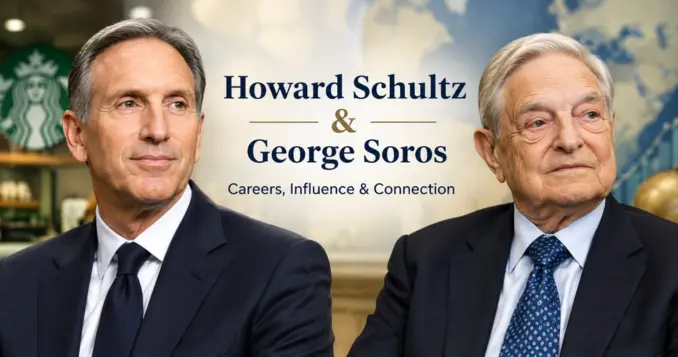
Howard Schultz and George Soros are two prominent figures whose names frequently appear in conversations about business, wealth, leadership, and social influence. Although they built their reputations in different industries and followed distinct professional paths, both have influenced how Americans think about entrepreneurship, economic opportunity, corporate responsibility, and the relationship between wealth and society.
Howard Schultz is best known for transforming Starbucks into an internationally recognized coffeehouse brand. His journey from a working-class childhood in Brooklyn to becoming one of America’s most recognizable business executives represents an influential example of entrepreneurial ambition. George Soros, meanwhile, established his reputation as an investor, philanthropist, and political advocate. His work in global financial markets and support for democratic institutions have made him an important figure in discussions about international finance and public policy.
Examining Howard Schultz and George Soros together provides an interesting opportunity to understand two different approaches to influence. One built a global consumer business around coffee, customer experience, and workplace culture. The other developed an international financial career and directed substantial resources toward education, civil society, and democratic initiatives.
Their stories reveal how individuals can shape public conversations and influence institutions beyond the industries in which they initially established their reputations.
Who Is Howard Schultz?
Howard Schultz is an American businessman best known for his leadership at Starbucks. Born on July 19, 1953, in Brooklyn, New York, he grew up in a working-class family. His early experiences helped shape his understanding of economic opportunity, employment, and the importance of creating a supportive workplace.
Schultz attended Northern Michigan University, where he earned a degree in communications. Before joining Starbucks, he worked in sales and business development, gaining experience that would eventually influence his approach to building a consumer-focused company.
His professional journey changed significantly in the early 1980s when he encountered Starbucks, which at the time primarily sold coffee beans and equipment rather than operating the extensive coffeehouse network familiar to modern consumers.
How Howard Schultz Transformed Starbucks
Schultz became interested in the Italian coffeehouse experience after visiting Milan. He recognized an opportunity to introduce a similar environment to American customers, where coffee could become part of a broader social experience rather than simply a product purchased for consumption.
After establishing his own coffee business, Il Giornale, Schultz acquired Starbucks in 1987 and began expanding the company around his vision.
His strategy emphasized several important elements:
- Creating comfortable coffeehouse environments.
- Developing consistent customer experiences.
- Expanding the availability of specialty coffee.
- Building a recognizable international brand.
- Investing in employee benefits and workplace culture.
Under his leadership, Starbucks expanded significantly across the United States and international markets.
Schultz’s business philosophy demonstrated that a company could compete through more than pricing and product availability. Brand identity, customer relationships, and organizational culture could also become important competitive advantages.
Howard Schultz’s Approach to Employee Welfare
One of the defining aspects of Schultz’s leadership was his public emphasis on employee benefits.
Starbucks became known for offering eligible employees access to certain healthcare benefits and educational opportunities. Schultz frequently connected employee satisfaction with the company’s long-term success.
His approach challenged the idea that employee compensation and customer experience should always be treated as separate business considerations.
However, Starbucks has also faced criticism and labor-related disputes, particularly concerning unionization efforts and workplace conditions. These developments illustrate the complexity of translating corporate values into everyday employment practices.
For business leaders, the broader lesson is that organizational culture requires consistent implementation, accountability, and communication.
Who Is George Soros?
George Soros is a Hungarian-born American investor and philanthropist widely recognized for his influence in global financial markets and international civil society.
Born on August 12, 1930, in Budapest, Hungary, Soros experienced the dangers of Nazi occupation during World War II. After the war, he moved to the United Kingdom, where he studied at the London School of Economics.
His academic experience exposed him to the philosophical ideas of Karl Popper, particularly the concept of an open society. This philosophy later became an important influence on Soros’s philanthropic activities.
Soros eventually moved to the United States and established himself as a successful investor.
George Soros and His Success in Financial Markets
Soros founded Soros Fund Management, which became associated with some of the most recognizable investment strategies in modern financial history.
He is particularly known for his approach to macroeconomic investing, which involves examining broad economic trends, monetary policies, currencies, interest rates, and geopolitical developments.
Rather than concentrating exclusively on individual companies, macro investors frequently evaluate how major economic changes can influence entire markets.
Soros became internationally famous following his 1992 currency trade involving the British pound. His investment strategy during the United Kingdom’s currency crisis earned him a prominent place in financial history.
This achievement contributed to his reputation as an influential investor with a strong understanding of international monetary systems.
George Soros’s Commitment to Philanthropy
Beyond investing, Soros is recognized for establishing and supporting the Open Society Foundations.
These organizations support initiatives involving:
- Education and academic opportunities.
- Independent journalism.
- Human rights protections.
- Democratic institutions.
- Government accountability.
- Public health initiatives.
- Civil society organizations.
Soros’s philanthropic philosophy reflects his belief that open societies depend on transparency, public participation, independent institutions, and the protection of individual freedoms.
His financial support for these causes has generated both recognition and political controversy, making him a frequently discussed figure in American and international public life.
Howard Schultz and George Soros: What Connects These Two Figures?
Although Howard Schultz and George Soros developed their careers in different industries, several themes connect their professional experiences.
Both built significant financial success, developed recognizable public identities, and used their influence in ways that extended beyond their original business activities.
Understanding these similarities helps explain why the two names can appear together in discussions about wealth, leadership, and American society.
Their Different Paths to Financial Success
Schultz developed his business reputation through consumer entrepreneurship and corporate management.
His success was closely connected to Starbucks, a company that changed how many Americans experienced coffee shops and specialty coffee.
Soros followed a different route. His financial success came primarily from investment management, particularly strategies based on global economic developments.
The distinction is important because entrepreneurship and investment management involve different skills.
Schultz focused on building an organization, developing products, managing employees, and expanding a consumer brand.
Soros concentrated on analyzing financial markets, identifying economic opportunities, and managing investment risks.
Both approaches demonstrate how different professional abilities can lead to substantial economic influence.
Their Influence Beyond Business
Neither figure has limited his public identity to commercial success.
Schultz has participated in American political discussions, including public conversations about economic inequality, employment, healthcare, and leadership. He also explored a potential independent presidential campaign in 2019.
Soros has become deeply involved in political and social advocacy through his philanthropic network and support for organizations associated with democratic participation and civil society.
Their activities illustrate two different forms of public influence.
One approach emphasizes corporate leadership and personal involvement in national discussions. The other involves directing philanthropic resources toward institutions, organizations, and long-term social initiatives.
Comparing Their Leadership Philosophies
Leadership is one of the most interesting subjects when examining Howard Schultz and George Soros.
Their professional environments required different management styles, but their careers reveal how vision and long-term thinking can influence major institutions.
Schultz’s Focus on Organizational Culture
Schultz’s leadership philosophy has often emphasized employees, customer relationships, and brand identity.
He understood that Starbucks needed to offer more than coffee to distinguish itself in a competitive marketplace.
The company’s coffeehouses became associated with convenience, social interaction, and a recognizable atmosphere.
This approach demonstrates the importance of creating an experience that customers value.
For entrepreneurs, Schultz’s career offers several lessons:
- Understand the needs of customers.
- Develop a recognizable brand identity.
- Build an organizational culture around clear principles.
- Maintain consistent product and service standards.
- Adapt to changing consumer expectations.
Soros’s Focus on Independent Thinking
Soros’s approach to investing and philanthropy reflects a different intellectual foundation.
His investment philosophy has been associated with reflexivity, the idea that market participants’ perceptions can influence economic conditions and, in turn, those conditions can influence market perceptions.
This perspective encourages investors to question assumptions and examine how expectations affect financial behavior.
His philanthropic philosophy similarly emphasizes the importance of critical thinking, institutional accountability, and open public debate.
For investors and organizational leaders, his career highlights the importance of intellectual flexibility, understanding uncertainty, and evaluating information from multiple perspectives.
Howard Schultz and George Soros on Philanthropy and Social Responsibility
Philanthropy provides another useful way to compare these influential Americans.
Both have been associated with efforts to address social issues, although their priorities, organizational structures, and approaches differ.
Howard Schultz’s Social Initiatives
Schultz has publicly supported initiatives related to economic opportunity, education, and community development.
His connection with Starbucks also brought attention to corporate social responsibility, particularly the relationship between employment practices and business performance.
Starbucks has introduced various programs and partnerships involving employee education, community engagement, and social initiatives over the years.
Nevertheless, corporate social responsibility should be evaluated through actual policies and measurable outcomes rather than public statements alone.
George Soros’s Philanthropic Network
Soros established the Open Society Foundations, which support organizations working on issues such as education, human rights, justice, and democratic governance.
His philanthropic approach is notable for its international scope.
Rather than concentrating exclusively on one company or community, his foundations have supported initiatives across numerous countries and regions.
The organization’s activities have also attracted political criticism, particularly from governments and groups that disagree with its advocacy priorities.
This demonstrates an important distinction between philanthropy and universally accepted public service. Large-scale charitable funding can produce meaningful social initiatives while also generating debate about accountability, political influence, and the role of private wealth.
Their Impact on American Politics and Public Debate
Howard Schultz and George Soros have both become recognizable names in American political discussions, but their involvement has taken different forms.
Schultz’s political visibility increased significantly when he considered running for president as an independent candidate in 2019. His public positions included discussions about government spending, economic policy, and political polarization.
Although he did not ultimately enter the presidential race, the possibility generated considerable debate about the role of wealthy business executives in American elections.
Soros has maintained a more sustained presence in political discussions through philanthropic funding and support for organizations working on public policy and democratic participation.
His activities have attracted strong supporters as well as vocal critics.
When discussing either individual, it is important to distinguish documented political activities from speculation or unsupported claims.
A person’s financial resources, public statements, and philanthropic contributions can be examined through available records. However, claims about hidden coordination or personal relationships require reliable evidence.
This distinction is particularly important when comparing prominent individuals whose names frequently appear in politically charged online discussions.
Similarities and Differences Between Howard Schultz and George Soros
A direct comparison helps clarify their individual contributions and professional identities.
| Category | Howard Schultz | George Soros |
|---|---|---|
| National identity | American | Hungarian-born American |
| Primary field | Business and entrepreneurship | Investment management |
| Known for | Starbucks leadership | Global financial investing |
| Major organization | Starbucks | Soros Fund Management |
| Philanthropic connection | Education and community initiatives | Open Society Foundations |
| Public influence | Corporate and political discussions | Financial and political discussions |
| Main professional strength | Brand development and management | Investment analysis and financial strategy |
The comparison demonstrates that Schultz and Soros represent different models of influence.
Schultz’s career illustrates the importance of building and managing a consumer-facing business. Soros’s career demonstrates how investment expertise and philanthropic resources can influence financial markets and civil society.
Neither individual’s achievements should be understood through a single dimension. Their professional decisions, public statements, and organizational activities provide a more complete picture.
Lessons Entrepreneurs and Business Professionals Can Learn From Them
The careers of Howard Schultz and George Soros offer valuable insights for people interested in entrepreneurship, investment management, and organizational leadership.
Although their industries differ, several principles are relevant across professional environments.
Build a Clear Long-Term Vision
Schultz recognized an opportunity to develop a different coffeehouse experience in the United States.
Soros developed an investment philosophy that encouraged examining the relationship between market expectations and economic reality.
Both examples demonstrate the importance of having a clear framework for decision-making.
A business owner should understand what makes a company different and how it can create lasting value.
An investor should understand the assumptions behind an investment strategy and the risks associated with changing market conditions.
Adapt to Changing Circumstances
Markets, customers, and institutions rarely remain unchanged.
Businesses must respond to evolving consumer preferences, technology, competition, and economic pressures.
Investors must also adjust their expectations when new information challenges existing assumptions.
Schultz’s experience with Starbucks and Soros’s investment career demonstrate why adaptability matters in long-term professional success.
Understand the Responsibility That Comes With Influence
Financial success can provide opportunities to support education, community initiatives, public institutions, and other causes.
However, influence also creates expectations of transparency and accountability.
Companies must consider how their decisions affect employees, customers, and communities.
Investors and philanthropists must consider how financial resources influence organizations and public debate.
Responsible leadership involves recognizing these broader consequences.
Frequently Asked Questions
1. Who are Howard Schultz and George Soros?
Howard Schultz is an American businessman best known for transforming Starbucks into a major international coffeehouse company. George Soros is a Hungarian-born American investor and philanthropist known for his financial market activities and the Open Society Foundations.
2. What is Howard Schultz famous for?
Howard Schultz is best known for expanding Starbucks and developing its international coffeehouse business model. He also became recognized for his focus on employee benefits, customer experience, and corporate culture.
3. What is George Soros famous for?
George Soros is famous for his success in global financial markets, particularly his 1992 trade involving the British pound. He is also known for establishing the Open Society Foundations.
4. Are Howard Schultz and George Soros business partners?
There is no widely established public evidence that Howard Schultz and George Soros are business partners. They are independently recognized for their different professional careers and public activities.
5. How did Howard Schultz become wealthy?
Schultz accumulated substantial wealth through his leadership and ownership-related financial interests in Starbucks. The company’s growth into a global coffeehouse business played a major role in his financial success.
6. How did George Soros make his fortune?
Soros built his fortune primarily through investment management. His macroeconomic investment strategies and successful financial market positions helped establish his international reputation.
7. What is the Open Society Foundations?
The Open Society Foundations is a philanthropic network established by George Soros. It supports initiatives involving education, human rights, democratic governance, independent journalism, and civil society.
8. Did Howard Schultz run for president?
Howard Schultz considered running for president as an independent candidate in 2019. However, he ultimately decided not to enter the presidential election.
9. What makes their leadership styles different?
Schultz’s leadership style has focused on organizational culture, customer experience, and building a consumer brand. Soros is associated with independent financial thinking, investment analysis, and philanthropic support for open societies.
10. Why are Howard Schultz and George Soros discussed together?
The two figures are sometimes discussed together because both have accumulated significant wealth and developed influence beyond their primary professional activities. Their careers also provide different perspectives on business leadership, philanthropy, and public engagement.
Conclusion
Howard Schultz and George Soros represent two distinct examples of how individuals can develop financial success and influence important conversations in American society.
Schultz’s journey demonstrates the potential of entrepreneurship, brand development, and organizational leadership. His work with Starbucks changed the American coffeehouse experience and established a recognizable international business.
Soros’s career illustrates the influence of investment expertise, economic analysis, and large-scale philanthropy. Through his financial activities and the Open Society Foundations, he has become an important figure in discussions about international markets, democratic institutions, and civil society.
Although their professional paths differ considerably, both individuals demonstrate that influence extends beyond financial achievements. Business decisions, investment strategies, philanthropic priorities, and public engagement can all shape institutions and communities.
Understanding Howard Schultz and George Soros requires looking beyond their wealth and public recognition. Their individual histories offer broader lessons about ambition, leadership, responsibility, and the many ways successful people can influence the modern world.